- search close
- menu close menu close
A motor nameplate may be small, but it carries a huge amount of critical information for the operation and maintenance of your motor. Understanding this information is key to being able to operate the motor safely and within the motor’s range of capabilities. It is also important to understand the information when you are looking to repair or replace your motor, so you can provide details of the motor you currently have.
Whether you’re specifying equipment, troubleshooting an issue, or simply looking to deepen your understanding, being able to read and interpret a motor nameplate is an essential skill.
In this guide, we’ll break down the key information found on a typical motor nameplate, explain what each element means, and show you how to apply it in real-world scenarios.
This is an example of a motor nameplate. This example is a Brook Crompton motor nameplate.
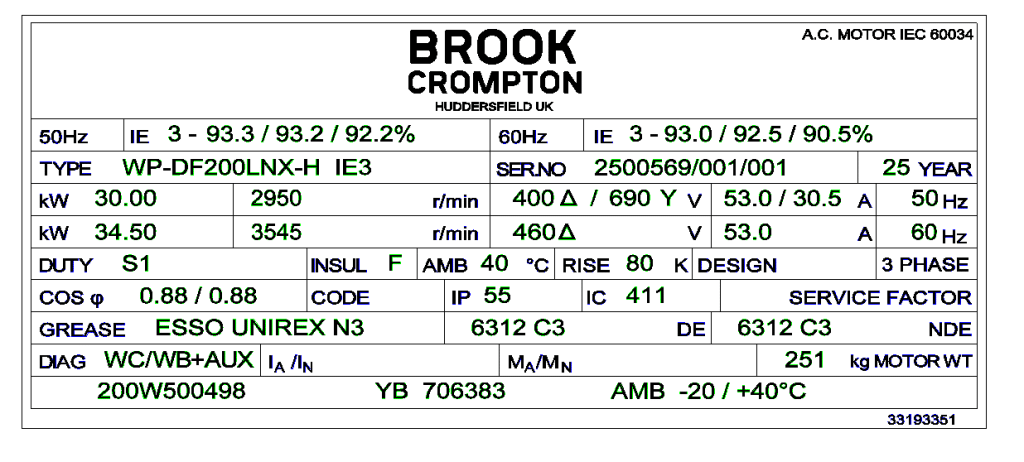 At first glance, a nameplate can look like a dense collection of numbers, abbreviations, and technical markings. However, each element serves a specific purpose, providing a clear and standardised snapshot of the motor’s design, performance, and operating limits. From electrical characteristics like voltage and current, to mechanical details such as speed and duty cycle, the nameplate is essentially the motor’s identity card.
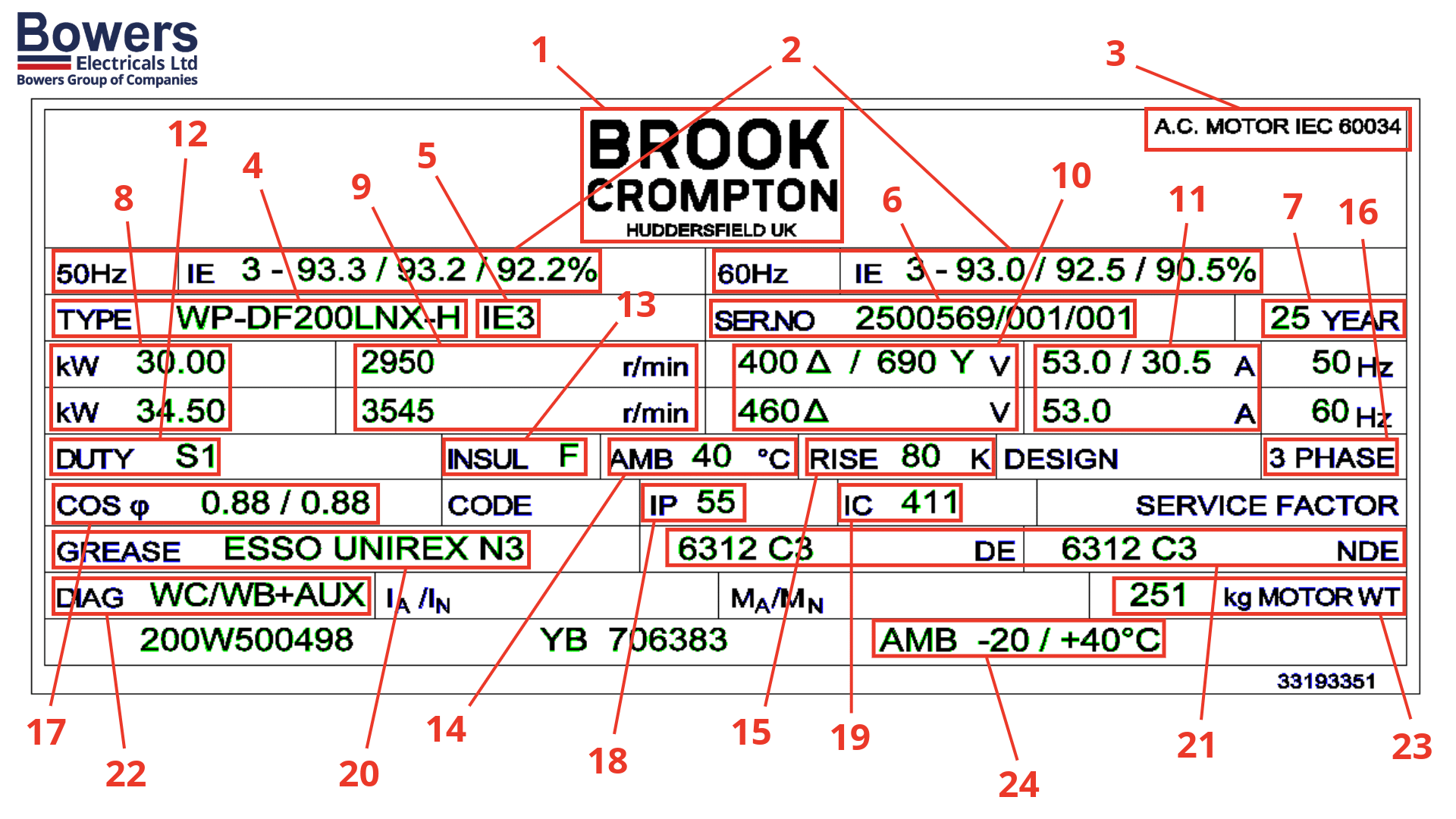 1. Manufacturer – Each motor name plate will have the name/ logo of the manufacturer of the motor on it. In this case, the Brook Crompton logo acts as your assurance of who made the motor and the level of engineering and standards behind it. Bowers Electricals are an approved Brook Crompton Motor Centre, meaning we can supply their complete range of motors. Find out more about our new motor offerings here.
2. Efficiency Ratings (50Hz & 60Hz) – Efficiency is a key indicator of how effectively a motor converts electrical energy into mechanical output. On this nameplate, efficiency is presented in a more detailed format, showing performance across both operating frequency and load conditions.
For 50Hz operation, the motor is classified as IE3, indicating a premium efficiency motor in line with IEC standards. The three efficiency values shown represent performance at:
100% load → 93.3%, 75% load → 93.2%, 50% load → 92.2%
For 60Hz operation, the motor maintains an IE3 classification, with efficiency values corresponding to:
100% load → 93.0%, 75% load → 92.5%, 50% load → 90.5%
Presenting efficiency in this way provides a more accurate reflection of real-world performance. While motors are often rated at full load, many applications operate below this level, making part-load efficiency an important consideration.
3. Reference Standard – This indicates the International Standard, defined by the IEC, that the motor is manufactured to, which defines a set of standard voltages for use in low voltage and high voltage AC and DC electricity supply systems.
4. Motor Type – This is the manufacturer’s model code, used to define the motor’s construction, size, and configuration within the range.
Each element of the code provides specific detail. In this case, “200L” refers to the frame size, where 200 indicates the shaft height in millimetres and “L” denotes a longer frame length within that size.
The prefixes and suffixes to this number provide details for the motor series, design variant, and additional build specifications, which may include factors like mounting arrangement, cooling method, or insulation class. Some of these identifiers are specific to the manufacturer, together they give a complete snapshot of the motor’s mechanical design and intended application.
5. Motor Efficiency Class – The IE rating indicates the motor class standard that this specific motor meets. In this case, it is IE3, meaning that the motor meets Premium Efficiency standards as defined by IEC classifications.
6. Serial Number – The serial number is unique to each motor. When it comes to diagnostics and maintenance, it is important to be able to identify the motor quickly and easily.
7. Year of Manufacture – This number on a motor nameplate indicates the year of manufacture. This information is useful for tracking the motor’s age, planning maintenance schedules, assessing warranty status, and determining lifecycle expectations. It can also help with identifying the correct documentation, spare parts, or specifications relevant to that production period. In this case, it shows ’25 Year’, meaning it was produced in 2025.
8. Power – The motor’s power may be written in kilowatts (kW) or horsepower (hp). It will be written in kW on most motors (like in this case), but older motors may be rated in hp. The power indicates the mechanical output power the motor can deliver at the shaft under its rated operating conditions. In this nameplate’s case, it has the values for both 50 and 60Hz.
9. Speed/RPM – This is the maximum speed of the motor in revolutions per minute without a load present, and this information can also tell you how many poles your motor has. A motor requires a minimum of two poles per phase, and a 2-pole motor rotates fully for each polarity change.
10. Voltages – Where there is more than one voltage figure listed, the delta (symbol) connection is the low voltage connection, while the star (symbol) configuration is for a high-voltage connection.
11. Current (A) – These numbers refer to the motor’s rated current, measured in amperes (amps), shown as (A). This shows the amount of electrical current the motor will draw when operating at its rated voltage, frequency, and load.
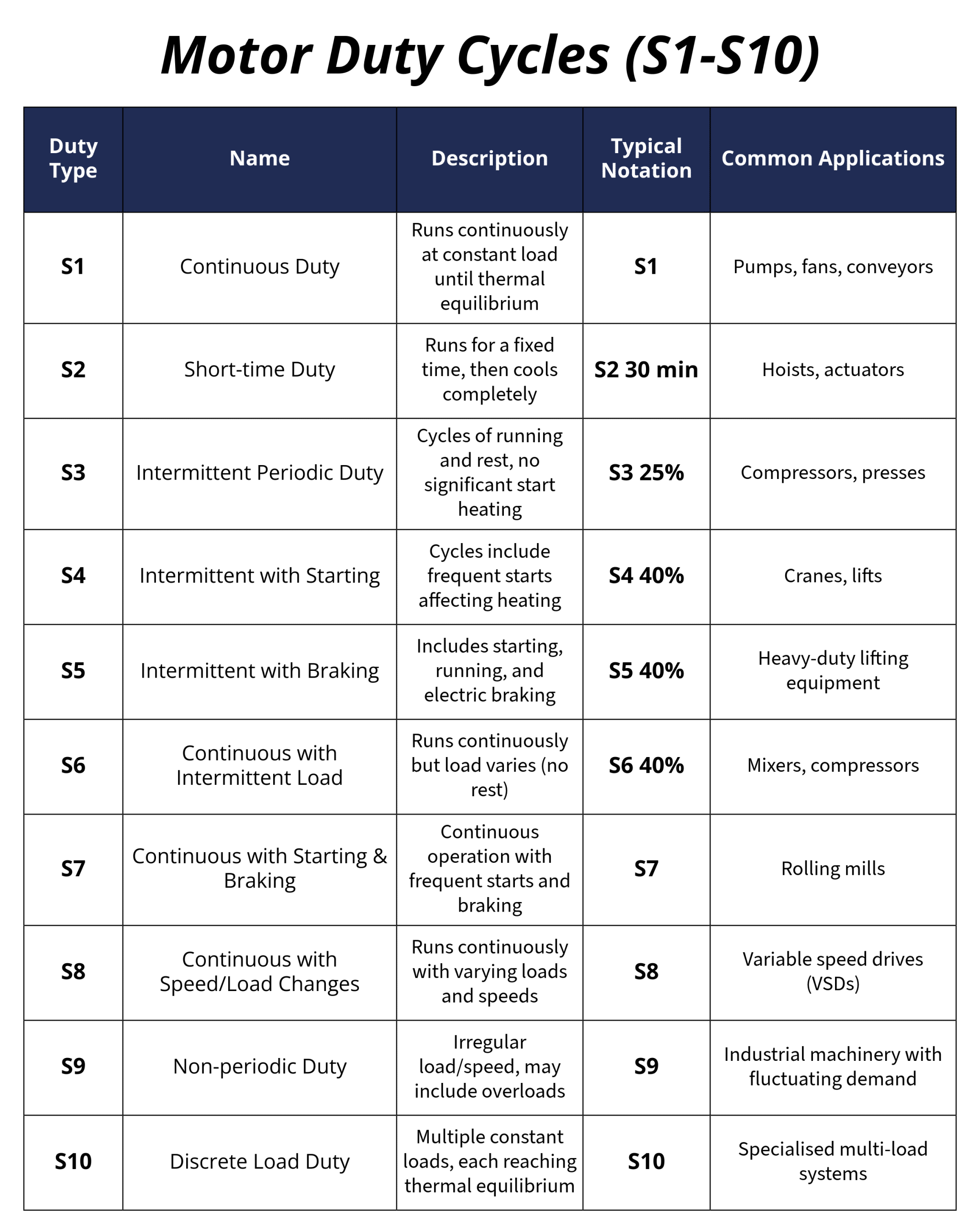
12. Duty Cycle – The duty cycle on a motor nameplate defines how the motor is designed to operate over time. This could be continuous or in cycles with rest periods, shown by an S rating. In our example, S1 stands for continuous duty and indicates that this motor has been designed to run 24/7, 365 days a year without issues, subject to scheduled maintenance. These S ratings range from S1 to S10, and all have different meanings, as shown by this table.
13. Insulation Class – Not all motor nameplates will show this, but this shows what insulation class the motor has been wound to. This class tells you how much heat the motor can safely withstand without damaging its internal insulation. The different classes are shown in this table.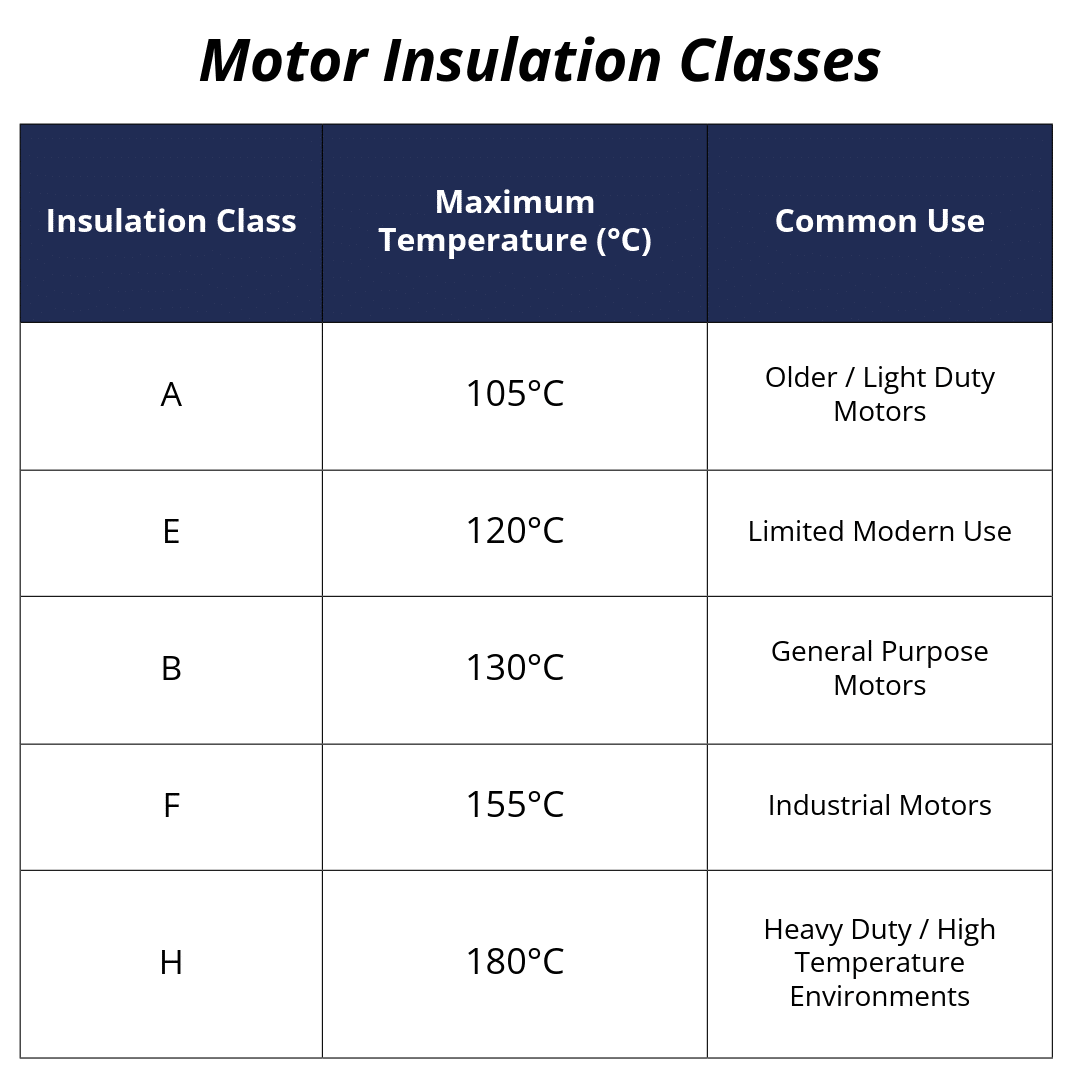 14. Temperature Rating – This shows what ambient temperature the motor can run in. In this example, it shows that the motor can run in an ambient temperature of up to 40°C.
15. Temperature Rise – This refers to the motor’s temperature rise, meaning how much the motor’s winding temperature is allowed to increase above the ambient temperature during operation. The figure is shown in as K (Kelvin), but for temperature rise, 1K = 1°C.
16. Phase Rating – This indicates the phase rating of the motor, being either single or three-phase.
17. Power Factor – The “cos φ” (cos phi) value on a motor nameplate refers to the motor’s power factor. This is a measure of how efficiently the motor uses electrical power.
18. IP Rating – IP stands for ingress protection. This shows the device’s ability to stop foreign material from entering and interfering with the motor’s operation. The first digit after the IP represents the level of protection from solid matter, and the second digit represents the level of protection from liquids. The first can range from 0, meaning no protection at all, to 6, meaning total protection from dust. The second goes from 0, meaning no protection from liquids, to 9, which is resisting high-pressure water jets. Your motors may also include other information, such as the Ex-symbol, applied to motors designed for use in potentially explosive environments.
19. Cooling Method – The “IC” on a motor nameplate stands for International Cooling, describing how the motor removes heat during operation. IC codes are typically three-digit numbers:
First digit → Type of enclosure or motor design (open, enclosed, ventilated),
Second digit → Cooling method for the air over the motor (internal or external),
Third digit → How the cooling air is moved (fan type, forced flow, natural convection).
20. Specified Lubrication – This refers to the method by which the motor’s bearings have been lubricated. This will often show a type of lubrication and a code for the exact type of lubrication. In this case, the nameplate shows grease and the specific grease code for the grease used. This is done to ensure proper protection and performance.
21. Bearing Designation (DE / NDE) – These figures shown are bearing codes that identify the type, size, and configuration of the bearings used to support the motor shaft. These values comprise:
Bearing type and series → Defines the construction (e.g. deep groove ball bearing) and load capacity
Bore size → Indicates the shaft diameter the bearing fits
Internal clearance (e.g. C3) → Shows how much internal space the bearing has to allow for thermal expansion during operation
In this case, the motor nameplate shows values for both Drive End (DE) and Non-Drive End (NDE). DE is where the motor connects to the driven equipment (e.g. pulley, fan, gearbox), and NDE is the opposite end of the motor.
22. Wiring Diagram Reference – This is simply the marking referring to the wiring diagram reference, indicating the specific connection layouts that can be used with the motor.
23. Motor Weight – The weight shown on a motor nameplate indicates the total mass of the motor, typically measured in kilograms (kg).
24. Ambient Temperature Range – This marking refers to the motor’s ambient temperature range, meaning the temperatures of the surrounding environment in which the motor is designed to operate safely.
Understanding a motor nameplate is more than just reading numbers. It’s vital to be able to know how each motor will perform, how to install it correctly, and how to keep it running reliably. Each value and figure means something different, and each plays a role in ensuring safe operation, efficiency, and longevity, making the nameplate an essential reference point for engineers, installers, and maintenance teams alike.